The Message of Isaiah
The kings Battle
Covenant Defender
The Coming Messiah
Hope of the World
Apply Today

Isaiah’s prophetic office began when the LORD gave him a vision of God’s throne. This vision came with a proclamation of judgment against Israel, Judah, and its surrounding nations.
All of which came true!
Between 740 to 681 BC, Isaiah prophesied faithfully throughout the southern kingdom of Judah. And like all prophets, his message had an immediate fulfillment, as well as a future fulfillment.
Because its stories speak to your heart, the Bible remains relevant generation after generation. God’s judgments and mercies renew with each successive regime upon the earth.
History of Judah
By birth Isaiah was someone of noble standing within the Jewish community of priests, prophets, and kings. Thus he was someone who could speak powerfully into the lives of kings. He had direct access to Judea’s throne of power, which amplified the influence and weight of his words.
The kingdom of Israel which had been united under kings David and Solomon had divided into two. The Northern Kingdom included 10 of the 12 tribes; the Southern Kingdom included the tribes of Judah and Benjamin.
Isaiah’s ministry begins spanned through the reigns of four Judean kings (see figure 1).
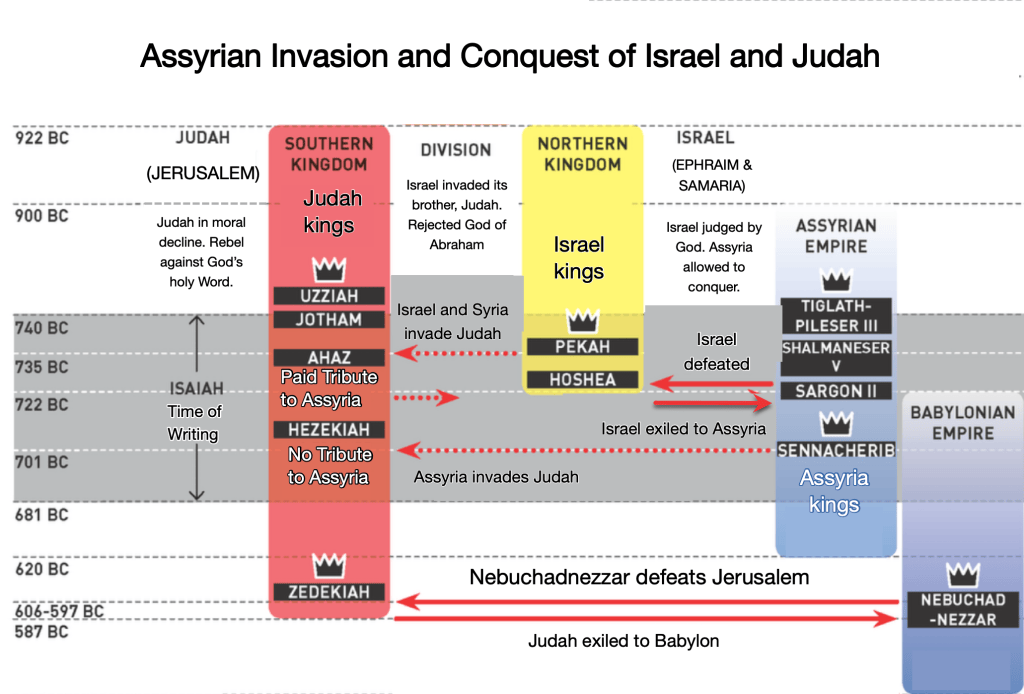
Figure 1
The first king that Isaiah served was Uzziah. Even though king Uzziah had great prosperity and military might, the power of the Assyrian nation was rising. Both kings Uzziah and Jotham managed to remain neutral to the rising powers surrounding them.
However, when king Ahaz came to power, king Pekah of the Northern Kingdom of Israel joined with king Rezin of Syria (Aram) to overthrow him. Kings Pekah and Rezin wanted to force king Ahaz to join their alliance against the growing threat of Assyria.
Ahaz, however, wanted to join with Assyria. Thus Pekah aimed to overthrow his Hebrew brother, Ahaz. According to 2 Chronicles 28:5-6, king Pekah of Israel (with the help of Syria) defeated Judah in a single day. One hundred twenty thousand (120,000) Judean soldiers were killed. Pekah installed a puppet king in Judah, Ben-Tabeel.
Isaiah then prophesied to Judah, and the surrounding nations, that Northern Israel would fall to Assyria because of their attack on their brothers in Judah.
Isaiah told Ahaz to turn to the LORD. Ahaz turned to Assyria instead. He appealed to Tiglath-Pileser III of Assyria for aid. Tiglath-Pileser III subsequently conquered much of northern Israel and Syria. In 722 BC, the Northern Kingdom fell to Assyria and the Israelites were eventually deported to Assyria.
Isaiah’s prophecy against the Northern Kingdom came true.
Defender of the Covenant
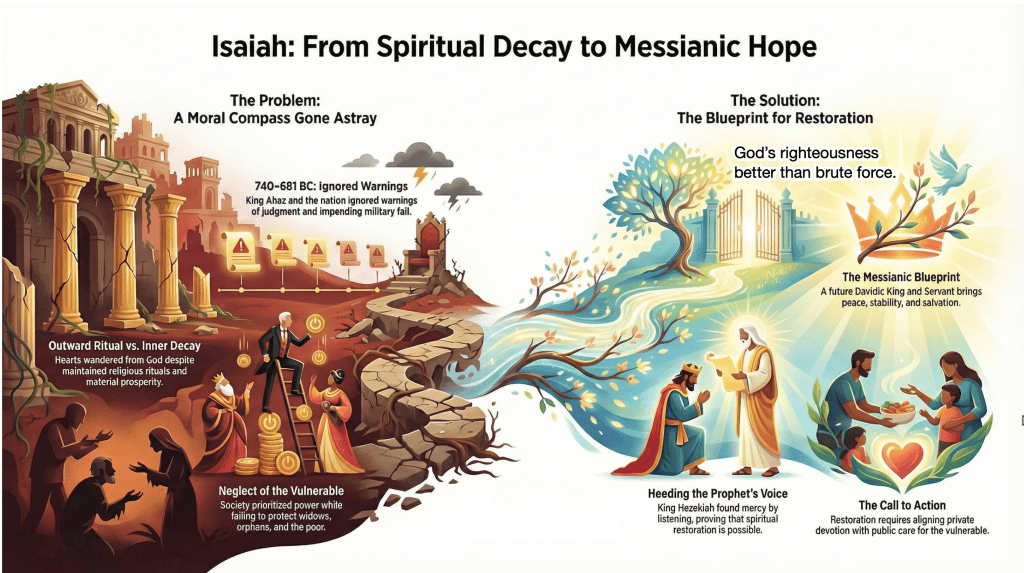
While the Judaens were prosperous materially, their behavior was ungodly. They did not value holiness like their forefathers Abraham, Isaac, and Jacob. Their moral compass had gone astray.
They wanted no part of doing good and gave no thought to protecting widows and orphans and the poor. This sounds a lot like the world today.
Beneath the surface of power and might, Judea was suffering severe moral and spiritual decay.
What happened to Judah? Click here to read more
Let’s be clear. Judah’s outward religious observances continued; yet their hearts had wandered far from God.
Idolatry, corruption and widespread injustice had become entrenched.
Almighty God had commissioned Isaiah to deliver Judah an urgent warning, “If the nation did not turn back to God, judgment would follow.
And like all prophets, Isaiah served as, “defender of the LORD’s covenant with Abraham, Isaac, and Jacob”. This covenant is what set Israel apart as one nation united.
“O LORD God!” Isaiah prayed. “Let the hearts of the people turn away from evil and return to following Your morality of goodness, loving-kindness, and mercy.”
King Ahaz followed the example of his father and grandfather. He ignored Isaiah’s warnings. Ahaz chose to partner with the Assyrians instead. He sought out the Assyrian army as his protector and paid tribute to their king.
Yet the LORD held back His righteous judgment because king Ahaz’s son, Hezekiah, heeded the voice of the LORD’s prophet. Hezekiah prayed,
“O God of my fathers, have mercy on my soul. Save my life, please! “
So God answered Hezekiah’s prayer. He showed Hezekiah mercy and held back the Assyrian threat.
Unfortunately, king Hezekiah became boastful and allowed foreign nations to see all Judah’s wealth and prosperity. Isaiah warned king Hezekiah against bragging, but to no avail.
Therefore, Isaiah predicted that the budding aggression of Babylon would eventually overthrow Judah and replace the Assyrian Empire as the world power (2 Kings 18-20; 2 Chronicles 32).
It was Babylon who eventually invaded Judah. Their king Nebuchadnezzar defeated Jerusalem and removed the Hebrews from the land of Judah.
God’s people were now exiled from the land God had promised Abraham, Isaac, and Jacob.
Isaiah’s prophecy against the Southern Kingdom came true.
The Coming Messiah and King
A significant theme of the Book of Isaiah is the hope in a future king from the line of David.
The book provides a blueprint for the coming Messiah who would be anointed as Prophet, Priest, and King.
It also develops an outline of God’s plan of salvation, including:
- the exaltation of Jerusalem (chapter. 2),
- the coming child who is to reign (chapter. 9),
- peace and stability during the reign of the Davidic heir (chapter. 11),
- how the ideal Servant of the Lord will carry out God’s mission (chapters. 42–53).
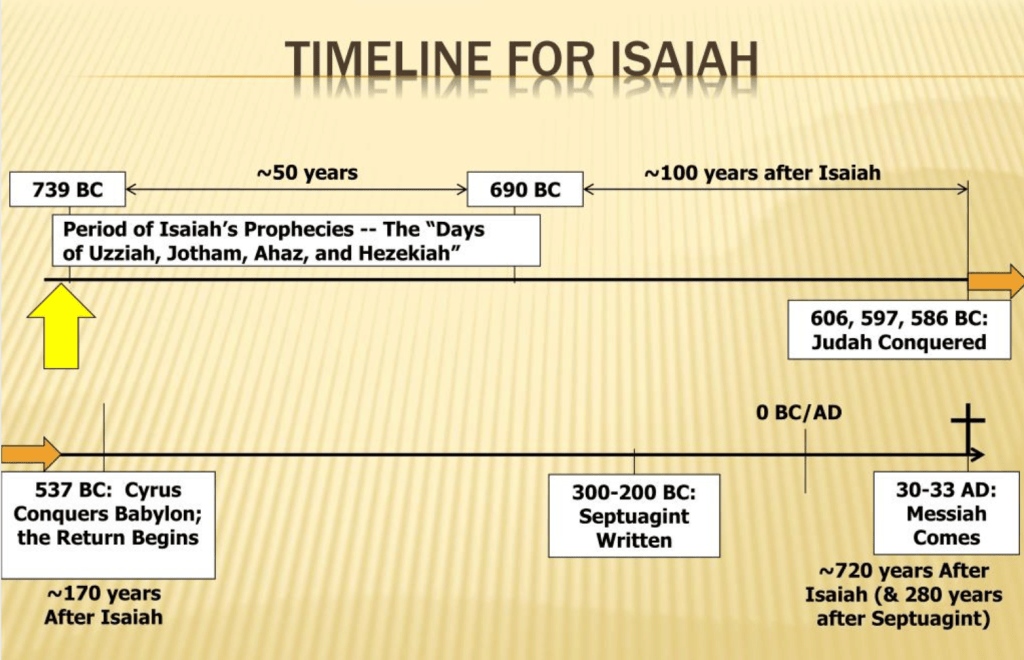
The Book of Isaiah is quoted more than all other Bible books. Chapter 53 contains Isaiah’s prophecy about the coming Messiah.
There are at least 7 quotes from Isaiah 53 in the New Testament. Yeshua, Himself, quotes Isaiah several times during His ministry on earth.
Below is a timeline from Isaiah the prophet to Yeshua the Messiah who comes to earth.
The Hope of Israel and the World (click to read more)
All looked lost. God had lovingly cared for Israel, His servant, but she had rebelled. The people oppressed the poor, ignored Isaiah’s warnings, and embraced idolatry.
As a consequence, Israel is exiled from the Promised Land. Things could not look more bleak.
Yet the LORD would not utterly abandon his people, Israel and Judah, because of His promise to Abraham, Isaac, and Jacob.
Amidst a nation stuck in selfish deceit and disobedience to God’s word, the LORD raised up the prophet, Isaiah, and his family. This nucleus remained unwavering in their obedience to the voice of God within their souls.
Isaiah spoke to his generation accurate messages of :
- warning
- hope
- redemption
Their trust in the LORD would never waver.
This should remind us today that there will always remain a faithful remnant.
The LORD will always keep His promise to those who love and obey His holy Word.
These are the ones sealed by Yeshua’s covenant of grace.
Who do you know personally that speaks the word of God openly and honestly?
Who is the one that speaks out against injustice?
Applications From Isaiah for Today
The people of Judah relied on political alliances and human strength instead of trusting God. Their spiritual and political, compromise would lead to their destruction.
Each successive king influenced the state of the nation. The people practiced idolatry and remained stuck in rebellion.
Therefore, Lord Jesus Christ said to His disciples,
“Great hardship and devastation are coming.”
(Matthew 24:21)
Think About
Isaiah’s mission was to speak God’s holy word to the Hebrew nation.
What about you?
To whose moral voice do you listen?
What is your mission to your nation?
What messages of warning and hope does the LORD want YOU to deliver to your community?
How can you best deliver that message?